If you manage receipts for multiple clients, you already know the feeling. The envelope that arrives two weeks late. The till receipt so faded you can barely read the supplier name. The client who swears they kept everything until they did not.
Paper receipts are not just an inconvenience for accountancy practices. They are a structural problem, and the costs compound quietly every single month.
This post breaks down exactly what paper receipts are costing your practice and what the alternative actually looks like in practice.
The Real Cost of Paper Receipts in Your Accountancy Practice
Start with time. Every paper receipt your team handles has to be opened, checked, manually keyed, filed, and eventually found again when someone needs it. For a practice with ten clients, that is a manageable annoyance. For a practice with fifty, it is a meaningful drain on capacity every single month.
The Institute of Chartered Accountants in England and Wales has consistently highlighted admin burden as one of the biggest barriers to practice growth. It is not complicated work but it takes real time, and that time has a cost.
Actionable takeaway: Track how long your team spends on receipt-related admin across one full month. Most practices find the number is higher than expected and that it maps almost directly to the cost of a digital alternative.
Why Paper Fails at Scale
A single paper receipt is a minor thing. A year's worth of paper receipts across a full client list is a different matter entirely.
Paper receipts fail in predictable ways. Thermal paper, the kind used in virtually every till receipt in the UK, fades with heat, light, and time. A receipt that is perfectly legible in March can be unreadable by September. Ink-jet printed receipts are more durable but still get wet, torn, and lost.
The failure is not random. It scales with volume. The more receipts your clients generate, the higher the probability that some will arrive late, some will arrive damaged, and some will not arrive at all. And because those failures are distributed across dozens of clients, they rarely look like a single big problem. They just look like background noise, a constant, low-level friction that your team absorbs without ever quite resolving.
The knock-on effect matters. Every missing receipt creates a gap in the records. Every faded receipt means someone has to chase the client, wait for a response, and key the data manually when it finally arrives. Every late submission compresses your processing window and adds pressure at exactly the wrong moment.
Actionable takeaway: Build a simple log of receipt-related chases over a single month, supplier, reason, time to resolve. The pattern usually makes the case for change on its own.
The Storage and Search Problem
Filing systems feel like a solution. They are not.
A paper receipt filing system requires physical space, ongoing maintenance, and a consistent approach across everyone who touches it. What looks organised in January rarely stays that way by December. And once a receipt is misfiled, it might as well not exist.
The search problem is where the real time goes. If a client's VAT return triggers a question about a receipt from eight months ago, someone on your team has to go and find it. In a well-maintained physical filing system, that might take ten minutes. In a typical one, it can take considerably longer or it cannot be found at all.
Multiply that across a full client list and you have a recurring, unpredictable drain on team time. No one books it as a cost. It never appears on a P&L. But it is real.
Digital receipt storage solves this completely. Every receipt is searchable by supplier, date, amount, or VAT status in seconds, from anywhere.
Actionable takeaway: The next time your team spends more than five minutes looking for a specific receipt, note it. If it happens more than twice a week across your client base, you have a storage problem that filing cannot fix.
The Compliance Exposure You May Be Underestimating
This is the cost that practices tend not to think about until it becomes a problem.
HMRC requires businesses to keep records of expenses for a minimum of six years. That is a long time to rely on physical documents. Paper fades. Filing cabinets get moved during office relocations. Receipts get lost between clients and practices. And when records cannot be produced during an inquiry or audit, the consequences fall on your client and on your relationship with them.
Under Making Tax Digital, the expectation is moving further towards digital record keeping. HMRC already accepts digital copies of receipts as valid records, provided they are a true and accurate reproduction of the original. For practices that have not yet made the shift, there is a practical compliance gap that grows a little wider every year.
The risk is not hypothetical. A receipt from three years ago that cannot be produced is not a minor administrative gap. During an HMRC inquiry, it is a problem. And it is one that falls on you to explain.
Actionable takeaway: Review your current receipt retention process against HMRC's six-year requirement. If you cannot confidently say every client's records are complete and retrievable for that full period, that is the compliance gap to close first.
The Environmental Cost: Smaller Than You Think, Bigger Than It Should Be
Most till receipts in the UK are printed on thermal paper. Thermal paper is coated with BPA or BPS to produce the heat-sensitive surface that creates the print. That coating makes it non-recyclable through standard recycling streams.
For an individual, this is a minor issue. For an accountancy practice processing hundreds or thousands of receipts a month across a client base, it adds up to a meaningful and largely invisible environmental footprint, one that most practices have never quantified.
This matters increasingly for two reasons. First, practices committed to sustainability are right to identify it as an area for improvement. Second, clients, particularly those with their own ESG commitments, are paying more attention to the operational choices of the firms they work with. A practice that still runs on paper is not always a dealbreaker, but it is increasingly a point of contrast.
Going digital removes this friction entirely. No physical receipts means no thermal paper waste and a straightforward answer to any client who asks about your environmental approach.
Actionable takeaway: If your practice has a sustainability policy or is working towards one, add receipt management to the list. It is a simple, low-effort win that has a real and measurable impact.
The Hidden Cost to Client Relationships
This one rarely gets discussed, but it is real.
When clients have to chase receipts, dig through bags, photograph things they have already sent, and answer follow-up questions about records they thought were sorted that experience creates friction. It is not friction they will necessarily complain about. But it shapes how they feel about working with you.
Practices that make the submission process easy tend to get better data, faster. Clients who can forward a receipt by email, photograph it on their phone, or drop it into a portal tend to do it promptly. Clients who have to gather physical documents tend to leave it until they have to.
The quality of your records is directly connected to how easy you make it for clients to submit. A client submission portal where clients can upload and track their own receipts without needing to log in or learn new software removes most of the friction at source.
Accuracy starts with a snap. When the process is that simple, clients actually use it.
Actionable takeaway: Ask yourself honestly: how easy is it for your most disorganised client to submit a receipt right now? If the answer involves envelopes, scanning, or any kind of manual chase, that is where the relationship friction lives.
What Digital Receipt Management Actually Looks Like
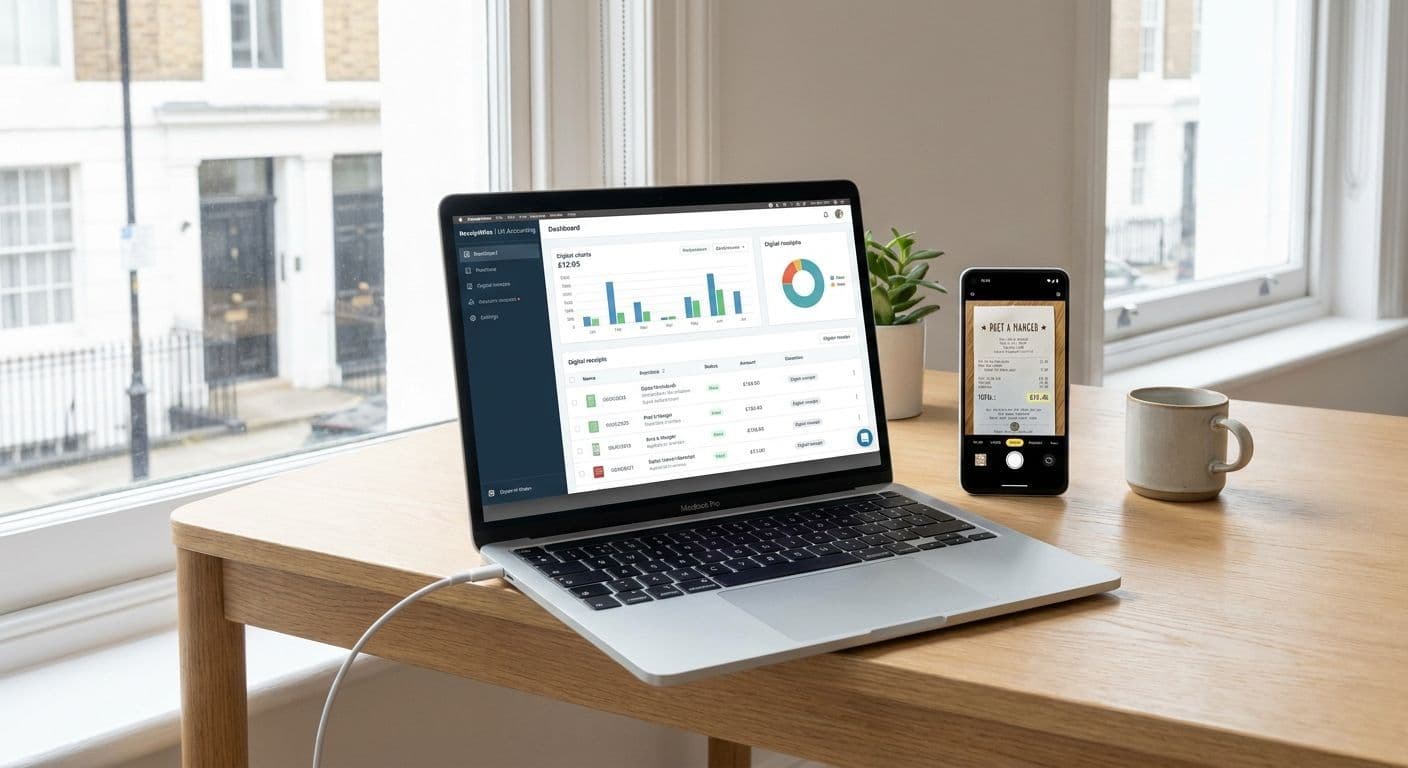
Digital receipt management is not a complicated proposition. Receipts are captured, by photo, file upload, email, or bulk import, and the data comes back instantly: supplier, date, VAT, totals. No typing. No chasing. No manual input.
A tool like Receiptflow is built specifically for UK accountants and bookkeepers. Clients can submit receipts by forwarding an email to a unique address no login needed. Your team gets a review dashboard where exceptions are flagged and approvals are centralised. Everything exports directly to Xero, FreeAgent, or QuickBooks. EU-based storage, UK GDPR compliant.
The transition is simpler than most practices expect. Most teams are fully operational within a few days. The difference is noticeable from the first week.
Actionable takeaway: Run the numbers on your current admin cost, time spent on receipt processing, storage, chasing, and resolving compliance gaps. Then compare it to what a digital tool costs. The maths is usually straightforward.
Frequently Asked Questions
Are digital receipts legally accepted by HMRC?
Yes. HMRC accepts digital copies of receipts as valid records, provided they are a true and accurate reproduction of the original. Digital storage is fully compliant with HMRC requirements and is often more reliable than paper for long-term record keeping.
How long do accountancy practices need to keep client expense records?
HMRC requires businesses to retain expense records for a minimum of six years from the end of the relevant tax year. For accountancy practices managing records on behalf of clients, this obligation applies to the underlying data, regardless of whether it is stored digitally or on paper.
What happens if a paper receipt fades or gets lost?
A missing or illegible receipt can cause issues during an HMRC inquiry. If a record cannot be produced, the expense may be disqualified. Capturing a digital record, via photo or email, creates a permanent, searchable record immediately and removes the risk of physical loss or fading.
Is thermal paper really not recyclable?
Correct. Most UK till receipts are printed on thermal paper coated with BPA or BPS, which prevents them from being processed through standard recycling streams. Switching to digital receipts eliminates this physical waste and is a simple way for practices to improve their environmental impact.
How does Making Tax Digital (MTD) affect receipt management?
MTD is shifting businesses toward digital record keeping by default. Practices that adopt digital receipt management now are staying ahead of HMRC requirements and avoiding the inevitable disruption of a last-minute, reactive transition later.
Can clients submit receipts without logging into a system?
Yes. With Receiptflow’s email-in feature, clients can simply forward their receipts to a unique address. There is no need for them to remember a login or manage an account, which removes the biggest barrier to getting clients to submit their expenses on time.
How quickly can a practice switch to digital receipt management?
Most practices can complete the transition within a few days. Modern tools are designed for rapid onboarding and direct integration with existing accountancy software, meaning there is very little disruption to your current daily workflow.